
The UNESCO Site Near Seoul Nobody Talks About
In This Article

This video is used under the Korea Open Government License (KOGL) Type 1, provided by the Korea Heritage Agency (k-heritage.tv).
There Is a UNESCO World Heritage Site 30 Minutes from Seoul
Most visitors to Korea go to Gyeongbokgung Palace, walk across Cheonggyecheon Stream, and call it a day. Very few make the 30-minute trip south to Suwon. That is a mistake. Hwaseong Fortress, a 5.74-kilometer stone wall built in the 1790s, sits in the middle of a living city and carries a UNESCO World Heritage designation that most tourists have never heard of. It is one of the most complete and historically significant fortresses in East Asia, and almost nobody outside Korea talks about it.
It Was Built in Two Years
Construction of Hwaseong began in 1794 and finished in 1796. Two years and eight months. For a fortress of this scale, that timeline is almost unbelievable. The speed came from a combination of visionary planning, a scholar who invented new machinery, and a king who was determined to see it finished. King Jeongjo, one of the most reform-minded rulers of the Joseon Dynasty, ordered the construction as part of a larger plan to build a new city that would rival Seoul in economic power.
A Scholar Invented Machines Just for This Project
The man who designed Hwaseong was Jeong Yakyong, Korea's most celebrated Silhak (실학) scholar. Silhak means practical learning, and Jeong took that literally. He studied Korean and Chinese fortress construction methods, then created something new. He invented the GEOJUNGGI (거중기), a pulley system capable of lifting massive stone blocks that previously required dozens of workers. He also designed the YURUNGEO (유형거), a reinforced cart built to carry heavy materials across rough terrain. These inventions cut construction costs significantly and made the two-year timeline possible.
The Fortress Has Features That Did Not Exist Anywhere Else
Hwaseong was not just built fast. It was built smart. The fortress combined Korean and Chinese military architecture in ways that had never been attempted before. It includes hollow watchtowers called GONGSIMDON (공심돈) that allowed soldiers to observe enemies from inside a concealed structure. It has artillery platforms called PORU (포루) specifically designed for cannon fire. There are corner pavilions called GANGNU (각루) positioned at natural high points, and a military command post called JANGDAE (장대) where generals directed battles. Every element was placed to use the natural landscape as an advantage.
A 200-Year-Old Book Saved It
Hwaseong was damaged during the Korean War. Large sections of the wall and several structures were destroyed. What made full restoration possible was a document called the HWASEONG SEONGYEOK UIGWE (화성성역의궤), a construction report completed in 1801. This was not a general summary. It contained architectural drawings for every structure, illustrations of every machine used during construction, and precise measurements of every material that went into the fortress. When restoration teams began work decades later, they used this document to rebuild Hwaseong exactly as it had originally been built. The book did not just record history. It kept the fortress alive.
It Is Not a Ruin. It Is a Living City.
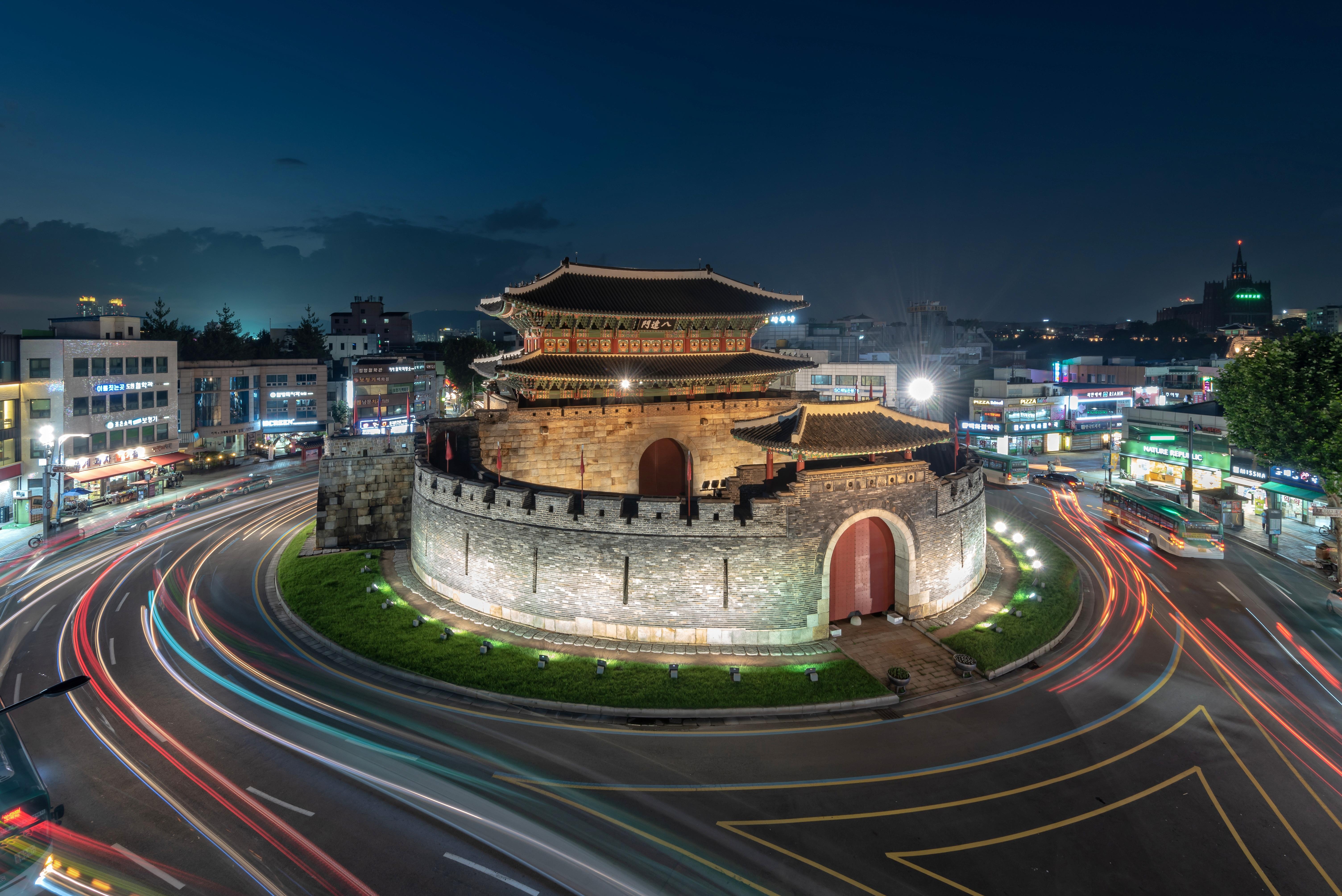
This is what makes Hwaseong genuinely different from most UNESCO sites. The fortress wall does not sit in an empty field or behind a museum barrier. It runs through a real neighborhood. People walk past it on their way to work. A traditional market operates in the shadow of the southern gate, Paldalmun (팔달문). Restaurants and shops line the streets inside the walls. Haenggung Palace (행궁), the temporary royal residence King Jeongjo used during his visits to Suwon, has been restored and sits just inside the western wall. Walking the full perimeter of Hwaseong takes about two hours and passes through a city that has been continuously inhabited for over two centuries.
How to Get There
Hwaseong is in Suwon, reachable from Seoul in about 30 minutes by subway on Line 1, or by KTX train in under 20 minutes. The most common starting point is Paldalmun, the southern gate, which is surrounded by Suwon's famous Paldalmun Market. From there, the path climbs toward Seojangtae (서장대), the western command post, which has panoramic views over the entire city. Entry to the fortress grounds is free. Some towers and platforms charge a small fee to enter. The walk is manageable for most visitors, though some sections are steep. Going on a weekday avoids the weekend crowds that gather near the palace area.