
JEOTGAL (젓갈): Korea's Forgotten Fermentation
In This Article
There Is Fermentation Inside Korean Fermentation
Most people who eat Korean food know about kimchi. Fewer know what makes kimchi taste the way it does. The answer is JEOTGAL (젓갈) — fermented seafood that functions as the hidden flavor engine inside Korea's most famous dish. Without JEOTGAL, kimchi would be a pickled vegetable. With it, kimchi becomes something fundamentally different: layered, deeply savory, and alive in a way that vinegar-based pickles are not.
But JEOTGAL is not only an ingredient. It is a category of fermented food in its own right — one that predates kimchi, spans hundreds of varieties, and represents one of the oldest and most widespread forms of food preservation in human history. It just rarely gets introduced on its own terms.
What JEOTGAL Actually Is
JEOTGAL is the Korean term for seafood — fish, shellfish, roe, or internal organs — preserved and fermented in salt. The salt concentration is high, typically between 15 and 30 percent depending on the variety and the intended use. At that concentration, most harmful bacteria cannot survive. What remains is a controlled environment in which the seafood's own enzymes, along with a small community of salt-tolerant microorganisms, slowly break down proteins and fats into amino acids, fatty acids, and aromatic compounds.
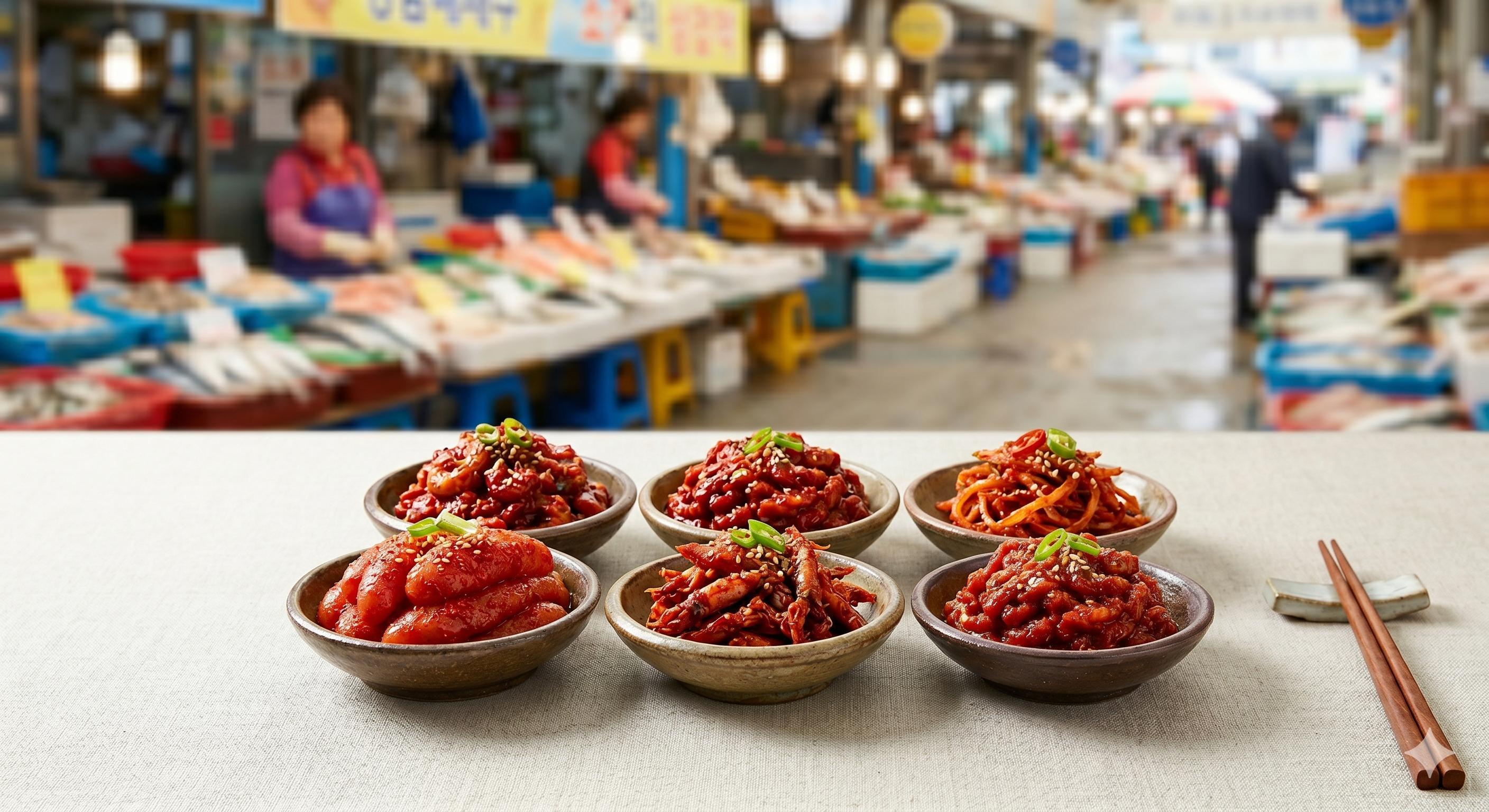
The result, over weeks or months, is a product that is intensely savory, deeply umami-rich, and shelf-stable without refrigeration. JEOTGAL can be eaten directly as a banchan (반찬) side dish, used as a seasoning paste, or incorporated into other fermented preparations. In Korean cooking, it functions the way fish sauce functions in Southeast Asian cuisines — as an invisible depth-builder that makes other flavors more complete.
The Science of Salt and Time
The fermentation that produces JEOTGAL is driven primarily by autolysis — the process by which the seafood's own endogenous enzymes break down its proteins and fats after death. In fresh seafood, these enzymes are kept in check by cellular structure. When salt is applied in high concentration, the cell walls break down and the enzymes are released, beginning a slow, controlled digestion of the raw material from the inside out.
Alongside autolysis, a community of halophilic — salt-loving — bacteria contributes to fermentation, particularly Lactobacillus and various salt-tolerant Bacillus strains. These bacteria produce lactic acid, which lowers the pH of the mixture and further inhibits spoilage organisms while contributing to flavor complexity. The interaction between autolytic enzyme activity and microbial fermentation is what gives JEOTGAL its characteristic depth — a flavor that is simultaneously salty, savory, slightly funky, and rich in free glutamates that activate umami receptors on the palate.
Temperature plays a significant role in determining the final character of the product. Fermentation at cooler temperatures, around 13 to 15 degrees Celsius, produces a more refined, less pungent result. Higher temperatures accelerate enzyme activity and produce a stronger, more assertive flavor. Regional differences in Korean JEOTGAL traditions partly reflect differences in climate and the seasonal timing of production.
A History Older Than Kimchi
The history of JEOTGAL in Korea is traced back at least to the Three Kingdoms period. The earliest surviving written reference appears in the Samguk Sagi (삼국사기), a Korean historical chronicle, in a record from the third year of King Sinmun's reign in 683 CE. The entry lists JEOTGAL among the foods offered as gifts during a royal wedding ceremony — suggesting it was already a valued and recognized product by that point, not a new invention.
Fermented seafood products appear in Chinese texts considerably earlier. The Erya (爾雅), a Chinese reference work dated to roughly the third to fifth century BCE, uses distinct terms for fish-based and meat-based fermented products — indicating that the practice was already established and categorized in the broader East Asian region well before Korean written records begin. Korean food historians generally place the origins of JEOTGAL in the Neolithic period, when coastal communities would have discovered natural fermentation through the observation of salted fish left in warm conditions.
By the Joseon Dynasty, the variety of JEOTGAL documented in culinary texts had expanded significantly. Different regions produced different varieties tied to local catches and seasonal availability. The practice of making JEOTGAL became structured around the fishing calendar, with specific varieties associated with specific months of the year.
The Main Types
Korean JEOTGAL is broadly divided into two categories. The first is jeot (젓) — straight salted and fermented seafood, where the primary ingredients are seafood and salt. The second is sikhae (식해) — a category in which fermented seafood is combined with cooked grains and vegetables, producing a product that is less intensely salty and more complex in flavor. Sikhae is particularly associated with the northern regions of Korea, where gamasik-sikhae and gajami-sikhae (fermented flatfish) are regional specialties.
Within the jeot category, the range of ingredients is wide. Saeujeot (새우젓), fermented salted shrimp, is the most widely used variety in kimchi production — particularly in baechu kimchi, where it contributes both flavor and the enzymes that help break down the cabbage during fermentation. Myeolchi-aekjeot (멸치액젓), anchovy fish sauce, is used as a liquid seasoning with a broader application range. Myeongnan-jeot (명란젓), fermented pollock roe, is eaten directly as a banchan and has developed significant international recognition through its adoption in Japanese cuisine as mentaiko. Ojingeo-jeot (오징어젓), fermented squid, and changnan-jeot (창난젓), fermented pollock intestines, are eaten as side dishes and represent the more assertively flavored end of the JEOTGAL spectrum.
The production calendar traditionally followed the seasons. Fermented oysters (어리굴젓) and myeongnan-jeot were made in winter, when the cold slows fermentation to a pace that produces a cleaner, more delicate flavor. Saeujeot was made in spring and autumn to coincide with shrimp harvest seasons, with autumn saeujeot — called chujeot (추젓) — considered the highest quality for kimchi use.
JEOTGAL Around the World
Fermented salted seafood is not uniquely Korean. The practice appears independently across cultures and continents wherever fishing communities existed and salt was available. Ancient Rome produced garum, a fermented fish sauce made from small fish and salt, used as a universal seasoning across the empire in a way that closely parallels how Korean myeolchi-aekjeot functions today. Southeast Asian cuisines built entire flavor systems around fish sauce — nuoc mam in Vietnam, nam pla in Thailand, patis in the Philippines. European traditions produced anchovy paste, Worcestershire sauce, and the Scandinavian specialty rakfisk.
What distinguishes Korean JEOTGAL within this global landscape is not the basic principle — salt plus seafood plus time — but the breadth of application and the diversity of forms. Korean cuisine uses fermented seafood not only as a condiment or seasoning liquid but as a direct food, an ingredient embedded within other fermented preparations, and a marker of regional and seasonal identity. The relationship between JEOTGAL and kimchi alone — where one fermented product actively participates in the fermentation of another — represents a layered use of fermentation that has few close parallels in other food cultures.
Why It Gets Overlooked
JEOTGAL rarely receives the attention that kimchi or JANG-based fermented foods do in international coverage of Korean cuisine. Part of this is a visibility problem: JEOTGAL is often an embedded ingredient rather than a featured dish. It works behind the scenes in kimchi, in soups, in seasoning pastes — contributing to flavor without presenting itself as the main event. Visitors to Korean restaurants may eat JEOTGAL regularly without knowing it by name.
Part of it is also a smell and texture challenge. The more assertive varieties — fermented squid intestines, fermented pollock organs — are not immediately approachable to people who did not grow up with them. They occupy the same category as aged cheese or fermented fish in European cuisines: deeply valued by those who know them, difficult to introduce without context.
But JEOTGAL is the flavor infrastructure of Korean food in a way that few single ingredients are. Understanding it explains why Korean fermented dishes taste the way they do — and why attempts to replicate them without it tend to fall short.
Why It Matters
JEOTGAL sits at the intersection of two things that define Korean fermentation culture: patience and layering. The patience required to ferment seafood correctly — to resist the instinct to eat it fresh, to trust the salt and the time — is the same patience that underlies DOENJANG and GANJANG. The layering — using a fermented product to deepen the fermentation of another — reflects a culinary logic that treats fermentation not as a single technique but as a system.
In a global food environment where fermented foods have attracted significant interest for their flavor complexity and potential health properties, JEOTGAL represents an underexplored category. It predates most of the fermented foods that have received international attention. It is more diverse in form than any single product category. And it connects Korean food to a fermentation tradition that spans the ancient world — from the fish markets of coastal Korea to the garum workshops of ancient Rome — in ways that reveal fermentation as one of the most universal human food practices.
The series that follows looks at the individual varieties in detail: saeujeot, myeongnan-jeot, ojingeo-jeot, and the liquid form that bridges JEOTGAL and modern seasoning — myeolchi-aekjeot. Each has its own production method, its own flavor character, and its own role in the Korean kitchen. Together, they form a fermentation tradition that has been running quietly in the background of Korean food for a very long time.