
MYEOLCHI-AEKJEOT (멸치액젓): Korea’s Essential Anchovy Sauce
In This Article
The Sauce That Makes Korean Food Taste Like Korean Food
There is a liquid in almost every Korean kitchen that most non-Korean visitors never notice. It does not appear as a dipping sauce or a table condiment. It does not have a distinctive color on the finished dish. It has no presence on the plate. And yet without it, Korean food tastes noticeably different — flatter, less complex, missing something that is hard to name but immediately apparent when it is gone. That liquid is MYEOLCHI-AEKJEOT (멸치액젓): fermented anchovy sauce, made from small fish, salt, and time.
It is not a secret ingredient in the dramatic sense. Every Korean cook knows it is there. It is simply so integrated into the baseline of Korean cooking that it rarely gets introduced on its own terms — even though it is doing more flavor work than almost anything else in the kitchen.
What MYEOLCHI-AEKJEOT Is
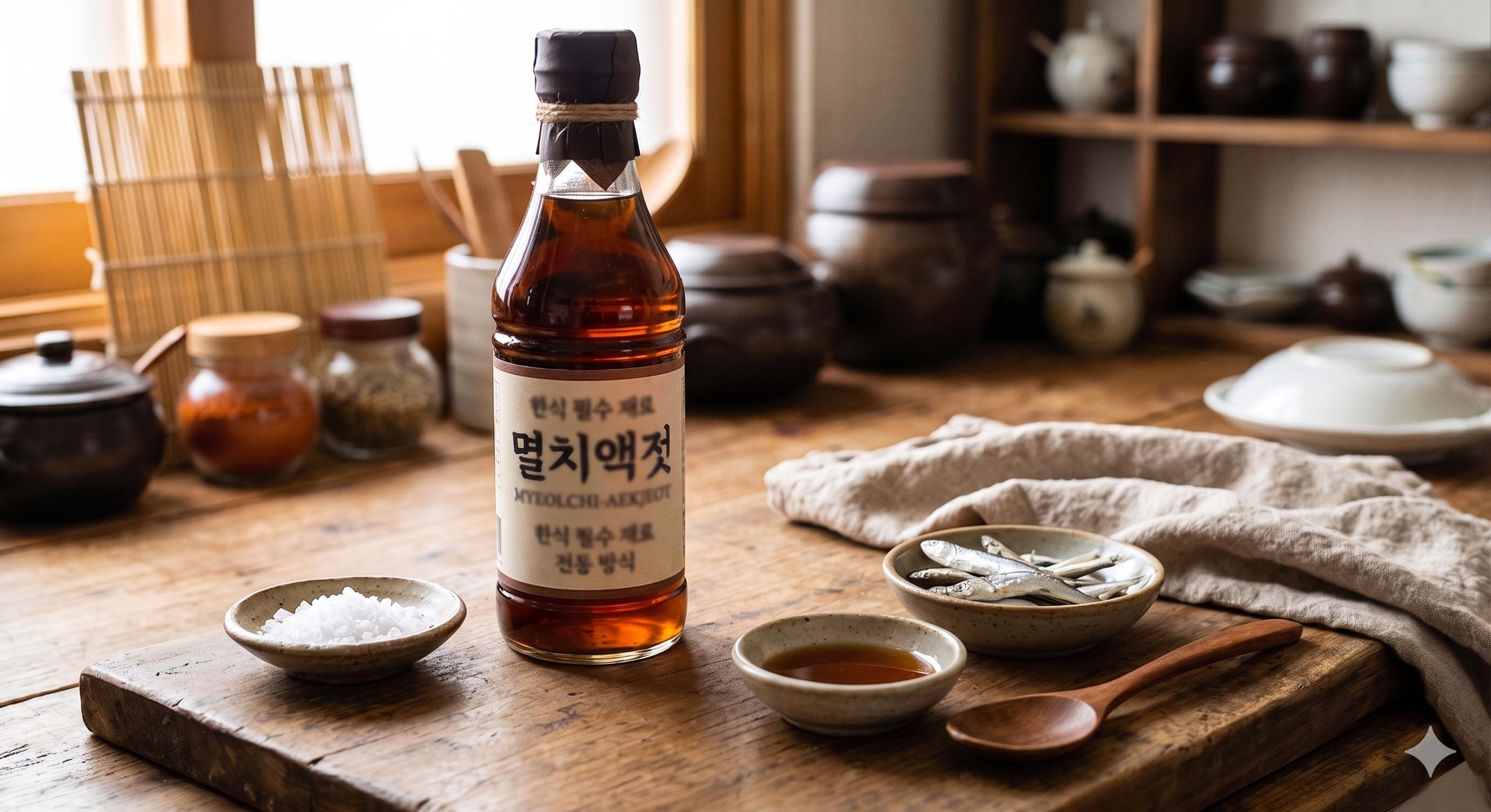
MYEOLCHI-AEKJEOT is the liquid produced by fermenting small anchovies in salt over an extended period, then straining out the solids to yield a clear, amber-colored sauce. MYEOLCHI (멸치) means anchovy in Korean; AEKJEOT (액젓) means liquid jeotgal — fermented seafood sauce. It is, in structural terms, the Korean equivalent of fish sauce: a condiment built from the enzymatic breakdown of fish protein in a high-salt environment, producing a liquid dense in free amino acids and therefore intensely savory.
The anchovies used are small — typically under ten centimeters — and used whole, including bones and internal organs. The organs contribute significantly to the enzyme activity that drives fermentation, and their inclusion is part of what gives MYEOLCHI-AEKJEOT its characteristic depth and slightly assertive aroma. It is not subtle, and it is not meant to be — it is a concentrated fermentation product designed to be used in small quantities where it can dissolve into a larger flavor system.
How It Is Made
Fresh anchovies are mixed with salt at a ratio that varies by producer and region but typically falls between 20 and 30 percent by weight. The salted fish are packed into large vessels — traditionally earthenware, increasingly food-grade plastic or stainless steel — and left to ferment at ambient temperature for a minimum of one year, with many producers aging their product for 12 to 24 months or longer. The salt concentration inhibits spoilage bacteria while permitting the activity of the fish's own endogenous enzymes and a community of salt-tolerant microorganisms.
Over the fermentation period, proteolytic enzymes break down the anchovy proteins into free amino acids — particularly glutamic acid, the primary carrier of umami flavor. The bones soften and eventually dissolve. The internal organs contribute additional enzymatic activity and flavor compounds. The resulting mixture is pressed and filtered to separate the liquid from the remaining solids. The liquid is then typically heated briefly to halt fermentation, stabilize the product, and reduce the fishy volatile compounds that would otherwise make the raw sauce too pungent for cooking use. The heating step also deepens the color from pale amber to the darker reddish-brown that characterizes finished MYEOLCHI-AEKJEOT.
The solid residue left after pressing — called myeolchi-yukjeot (멸치육젓) — is a thicker, more intensely flavored paste that retains more of the original fish character. It is used by cooks who want a stronger jeotgal flavor than the filtered liquid provides.
MYEOLCHI-AEKJEOT vs. KKANARI-AEKJEOT
In Korean kitchens, MYEOLCHI-AEKJEOT and KKANARI-AEKJEOT (까나리액젓) — fermented sand lance sauce — occupy the same functional role but produce different flavor results. Understanding the difference matters in practice, because experienced Korean cooks choose between them deliberately rather than treating them as interchangeable.
MYEOLCHI-AEKJEOT is deeper, more pungent, and more assertively savory. Its fermented character is more pronounced, with a stronger aroma and a flavor that lingers. It is the preferred choice for kimchi — particularly baechu kimchi, kkakdugi, and other fermented preparations where the sauce's intensity is absorbed and transformed during the kimchi's own fermentation process. The pungency that seems strong in the raw sauce mellows considerably as kimchi matures.
KKANARI-AEKJEOT is made from young sand lance, a small fish distinct from anchovy, harvested primarily in the spring along the western coast of Korea. It produces a cleaner, slightly sweeter sauce with less pronounced fishiness. It is preferred for water kimchi (mul-kimchi, 물김치), fresh seasoned vegetables, and dishes where a lighter hand is needed. Some cooks use kkanari-aekjeot exclusively and find myeolchi-aekjeot too strong; others use both for different applications. Neither is wrong — they reflect the same ingredient logic applied to different raw materials and different culinary goals.
The Same Idea, Every Continent
Fermented fish sauce is one of the most globally distributed condiments in culinary history. Ancient Rome produced garum — a sauce made from small fish fermented in salt under the Mediterranean sun — that functioned as the universal seasoning of the Roman kitchen in much the same way that MYEOLCHI-AEKJEOT functions in Korean cooking today. Garum was traded across the empire, produced in industrial quantities in coastal facilities, and used to add depth and salinity to dishes across all social classes.
Southeast Asia built some of its most distinctive culinary identities around fermented fish sauce: nuoc mam in Vietnam, nam pla in Thailand, patis in the Philippines, teuk trei in Cambodia. European cuisine retained anchovy-based condiments in different forms — anchovy paste, Worcestershire sauce, and the Italian colatura di alici, a direct descendant of garum still produced in Cetara on the Amalfi Coast. The principle in all of these is identical: small fish, salt, time, and the resulting concentration of amino acids that makes other ingredients taste more fully like themselves.
What distinguishes MYEOLCHI-AEKJEOT within this global family is its specific role as a fermented product used to facilitate another fermentation. In Korean kimchi, the sauce does not merely season — it actively participates in the fermentation of the cabbage, contributing enzymes and microbial compounds that shape how kimchi develops over time. That layered use of fermentation within fermentation is less common in other fish sauce traditions, where the sauce is typically a finished seasoning added to completed dishes rather than an active ingredient in a living fermentation process.
What It Does in Kimchi
MYEOLCHI-AEKJEOT contributes to kimchi at multiple levels simultaneously. As a seasoning, it provides salt and a concentrated load of free glutamates that deepen the overall umami of the kimchi paste, integrating with the gochugaru, garlic, and ginger to produce the layered flavor profile that distinguishes well-made kimchi from a simpler preparation. As a fermentation participant, its enzymes — particularly proteases — continue to act on the proteins in the kimchi ingredients during fermentation, contributing to flavor development over time.
The fishy aroma that is present in raw MYEOLCHI-AEKJEOT largely disappears during kimchi fermentation. The volatile compounds responsible for the fish smell — primarily trimethylamine and related molecules — are transformed or dissipate as the lactic acid bacteria of kimchi fermentation take over and the pH drops. What remains after that transformation is not fish flavor but a background savoriness and depth that would be absent if the aekjeot had not been included. This is why vegan kimchi, even when carefully seasoned to match the salt and heat levels of traditional recipes, often tastes different: the enzymatic and flavor contributions of fermented seafood are structural in a way that other ingredients do not replicate.
How Koreans Use It Beyond Kimchi
Outside of kimchi, MYEOLCHI-AEKJEOT functions as a liquid seasoning substitute for salt or soy sauce in applications where its depth is an advantage rather than a distraction. A small amount added to doenjang jjigae in place of some of the salt deepens the broth without adding identifiable fish flavor — the aekjeot disappears into the fermented paste, contributing to a more rounded result. The same logic applies to kongnamul-guk (콩나물국, bean sprout soup), miyeok-guk (미역국, seaweed soup), and various braised dishes where the cooking liquid benefits from the free glutamates in the sauce.
In seasoned vegetable dishes — the namul (나물) that appear across Korean meal tables as banchan — MYEOLCHI-AEKJEOT is used in small quantities to season spinach, fernbrake, and other vegetables after blanching, where it adds depth that plain salt does not. Jangajji (장아찌), Korean pickled vegetables, often use aekjeot as part of the pickling liquid for the same reason.
In Jeju Island, a regional variant called mel-jeot (멜젓) — made from Jeju anchovies — is used as a direct dipping sauce for grilled and boiled pork, in the same role that saeujeot plays in mainland Korean cooking with bossam. This use of anchovy sauce as a table condiment rather than a cooking ingredient is relatively uncommon on the mainland but reflects the broader range of applications that fermented fish sauce occupies in other culinary traditions globally.
Why It Disappears When You Cook It
One of the practical properties of MYEOLCHI-AEKJEOT that Korean cooks rely on is the volatility of its fishy aroma compounds under heat. The trimethylamine and related molecules responsible for the raw sauce's distinctive smell are volatile — they evaporate rapidly when heat is applied. This means that adding MYEOLCHI-AEKJEOT to a soup or stew during cooking produces a result that retains none of the identifiable fish aroma of the raw sauce. What remains is the non-volatile fraction: the free amino acids, the salinity, and the depth — without the smell.
This property is what allows MYEOLCHI-AEKJEOT to function as an invisible seasoning in cooked dishes. A cook who adds it to a vegetable soup does not produce a fishy soup. They produce a soup that tastes more complete, more savory, and more satisfying — without any identifiable fish character in the finished dish. The same principle applies to Western anchovy use in Italian sauces and Worcestershire sauce in British cooking: the fermented fish dissolves into the background and does what glutamates do, which is make everything around them taste more fully like themselves.
MYEOLCHI-AEKJEOT is not a fish sauce you taste. It is a fish sauce you feel — in the difference between a dish that is seasoned and a dish that is complete.