
TALCHUM(탈춤) : Korea's Rebellious Mask Dance Earns UNESCO Status
In This Article
When a Mask Changes Everything
Put on a mask, and suddenly you can say anything. In Korea, that idea became an art form. TALCHUM (탈춤) is a traditional Korean mask dance drama that combines dance, music, comedy, and sharp social satire -- all performed by dancers wearing wild, expressive masks. It is loud, funny, chaotic, and deeply human. And in 2022, UNESCO officially recognized it as an Intangible Cultural Heritage of Humanity.
The Word Itself Tells the Story
The name TALCHUM comes from two words: "tal" (탈), meaning mask, and "chum" (춤), meaning dance. Simple enough. But the tradition behind it goes back over a thousand years, rooted in ancient village shamanic rituals performed to drive away evil spirits and pray for good harvests. Over time, those rituals transformed into something far more entertaining -- and far more dangerous for those in power.
Comedy as Rebellion
Here is what makes TALCHUM genuinely remarkable. For centuries, ordinary Korean people had no voice. Farmers, merchants, and servants lived under the strict social hierarchy of the Joseon period, where the ruling yangban class held nearly all power. TALCHUM gave the voiceless a stage. Behind a mask, a performer could mock a corrupt nobleman, ridicule a hypocritical monk, or expose the absurdities of a system built to keep people in their place. The mask was not just a costume. It was protection and permission at the same time.
No Stage Required
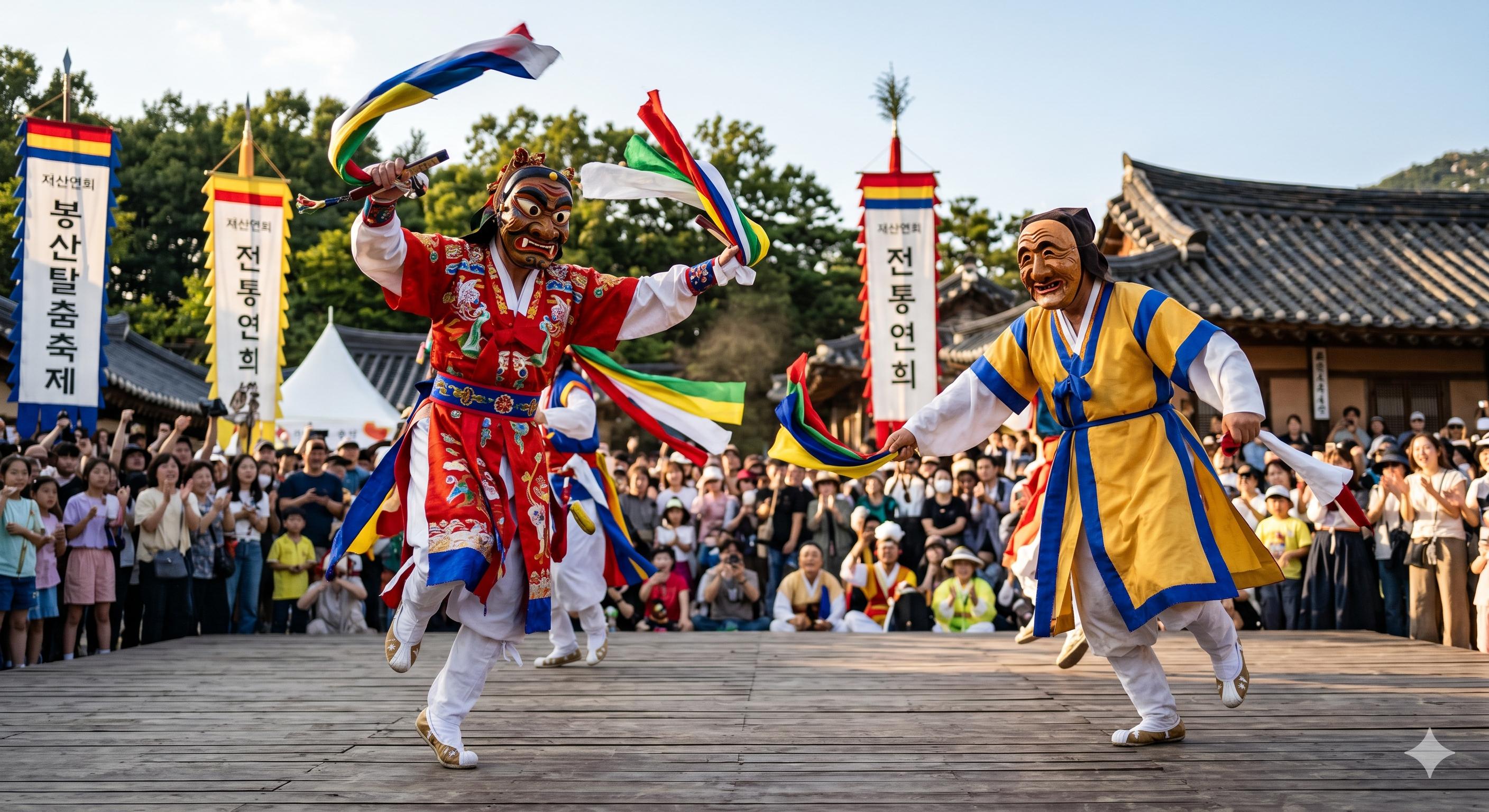
One of the most striking things about TALCHUM is how open and informal it is. There is no theatre, no ticketed seats, no formal stage. Any open space becomes the venue -- a village square, a riverbank, an open field. Performers move through the crowd, and the audience does not simply watch. They shout, cheer, boo, laugh, and sometimes jump in to join the performance. This interaction between performers and audience is central to TALCHUM's identity. It was always a shared experience, not a spectacle to be observed from a distance.
A Cast of Unforgettable Characters
TALCHUM performances feature a colorful roster of recurring characters. The pompous yangban nobleman stumbles around with exaggerated arrogance, only to be humiliated. The corrupt monk abandons his vows and chases after worldly pleasures. The sharp-tongued servant outwits everyone above him. Each character wears a distinctive mask -- some grotesque, some comic, some eerily beautiful. Masks are traditionally crafted from wood, particularly alder, or from papier-mache, and each regional style produces its own unique designs. Making a TALCHUM mask is itself considered a skilled craft.
Eighteen Styles, One Spirit
TALCHUM is not a single performance. Across Korea, eighteen distinct regional varieties exist, each with its own characters, dialect, music, and local flavor. Among the most well-known are BONGSAN TALCHUM from Hwanghae Province, YANGJU BYEOLSANDAE from Gyeonggi Province near Seoul, and HAHOE BYEOLSINGUT TALNORI from Andong in North Gyeongsang Province. The Andong Hahoe masks are particularly celebrated and are among the oldest surviving examples of Korean mask craftsmanship. An ensemble of six to ten musicians accompanies every performance, playing traditional instruments that drive the energy of the drama.
Kept Alive by Students
TALCHUM came close to fading out entirely. By the mid-twentieth century, modernization had pushed most traditional performing arts to the margins. But TALCHUM made a surprising comeback in the 1970s and 1980s, driven not by cultural institutions but by university students. Young people embraced the tradition's spirit of social criticism and used it to channel their own frustrations with the era. Campus clubs, student associations, and cultural camps became unexpected transmission points for an ancient art form. That generation continues to teach TALCHUM today.
UNESCO and What It Means
In November 2022, at the 17th session of the UNESCO Intergovernmental Committee for the Safeguarding of the Intangible Cultural Heritage, held in Rabat, Morocco, TALCHUM was added to the Representative List of the Intangible Cultural Heritage of Humanity. It became Korea's 22nd entry on the list, joining traditions like HAENYEO diving culture, SSIREUM wrestling, and YEONDEUNGHOE lantern festivals. UNESCO specifically noted that TALCHUM's message -- that all people deserve equal dignity and that power deserves scrutiny -- remains as relevant now as it ever was.
Where to See It
The video above is the official promotional footage of the 2025 Andong International Mask Dance Festival.
If you want to experience TALCHUM in person, Andong is the best starting point. The Andong Mask Dance Festival, held every autumn, is one of Korea's largest traditional performing arts events and draws visitors from around the world. The Hahoe Folk Village, a UNESCO World Heritage Site itself, regularly hosts performances in an authentic outdoor setting. In Seoul, the National Folk Museum and various cultural centers occasionally stage TALCHUM performances throughout the year. Wherever you see it, come ready to make noise. The performers expect it.