
Why Everyone Is Obsessed with Korean Spicy Food
In This Article
Pain as Entertainment
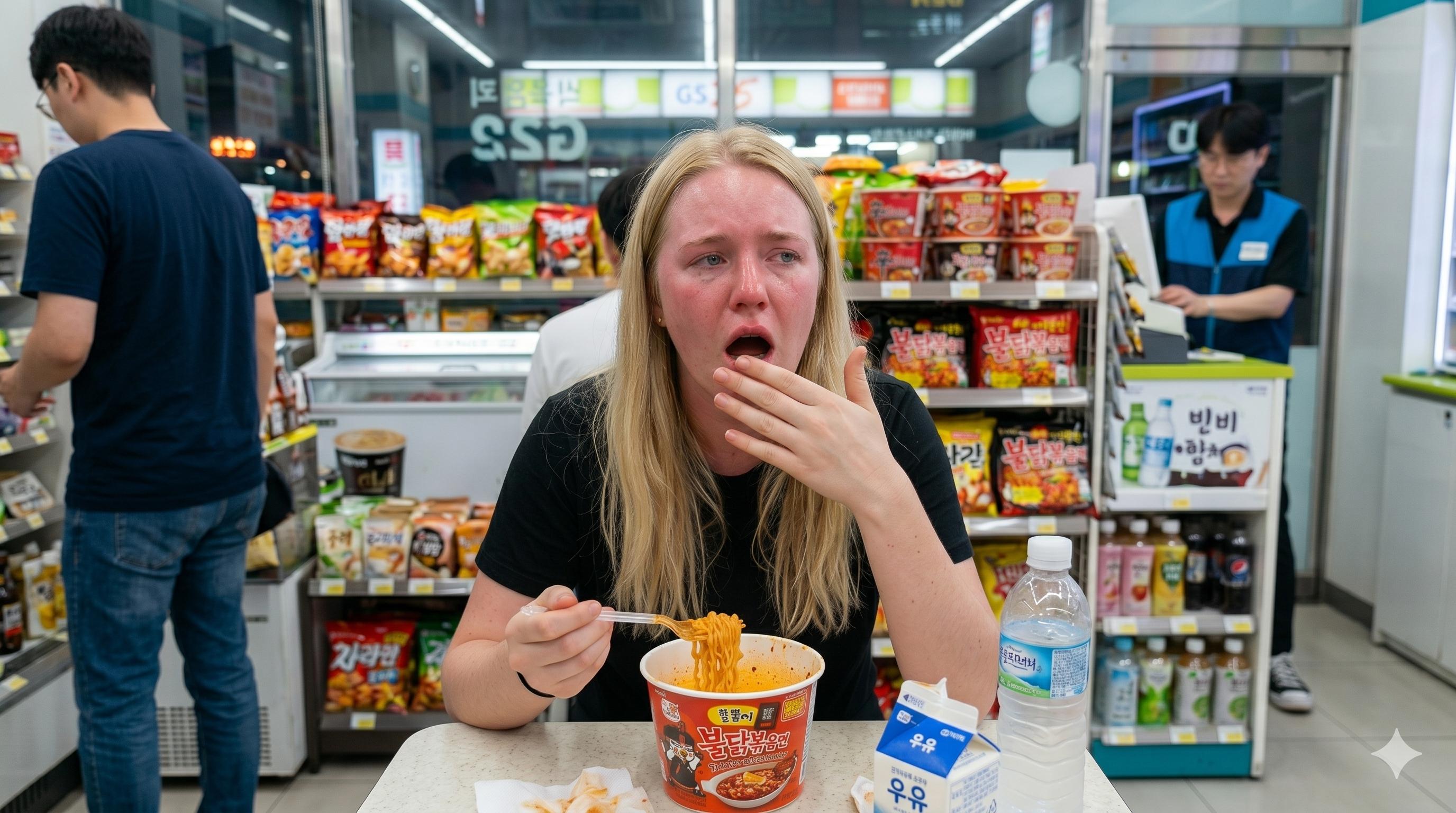
The spicy food challenge is not a Korean invention. Hot pepper eating competitions, capsaicin tolerance videos, and "can I finish this" content existed on YouTube long before Korean food entered the format. What Korean spicy food did was provide the challenge category with its most durable and globally recognized product: a specific instant noodle in a bright red package that has become shorthand, in online communities across languages, for a particular level of culinary suffering.
Buldak Bokkeum Myeon — produced by Samyang Foods and known internationally as "fire noodles" or "Korean fire chicken ramen" — is the most visible entry point, but the broader phenomenon includes tteokbokki at various heat levels, Korean convenience store spicy snacks, and the accumulated category of "extremely spicy Korean food" that has developed a distinct identity in global food content. The category has produced millions of reaction videos, spawned dedicated challenge formats, and driven consistent international sales growth for the products at its center.
How Buldak Bokkeum Myeon Became a Global Object
Samyang Foods launched Buldak Bokkeum Myeon in 2012, targeting domestic consumers seeking intensely spicy flavors. The product's international trajectory began through a specific type of online content: reaction videos in which non-Korean creators filmed themselves attempting to eat the noodles and recording their response to the heat.
The format spread rapidly because it provided reliable content structure. The product's heat level — significantly above what most international audiences had encountered in instant noodle form — produced consistent, visible, shareable reactions. The red packaging was visually distinct and recognizable across thumbnails. The product name was short enough to search. Every element of the object was optimized, accidentally, for the challenge video format.
Samyang subsequently released escalating heat variants — 2x Spicy, 3x Spicy, and limited editions positioned specifically around the challenge format — which extended the content cycle. Each new variant gave creators an existing audience familiar with the product a reason to produce new content. The product line and the challenge format developed in a feedback loop that sustained both.
The Challenge Structure: Why Suffering Works on Camera
The appeal of watching someone eat something extremely spicy operates on several simultaneous mechanisms. The first is spectacle: physical reactions to capsaicin — tearing eyes, reddening face, visible distress — are unambiguous and dramatic in a way that is easy to read across cultural and linguistic contexts. No translation is required to understand that someone is experiencing intense physical sensation.
The second is identification and comparison. Viewers who have attempted the same challenge — or who are considering it — watch the video partly to calibrate their own experience against the creator's. "Could I handle this" and "how does my reaction compare" are implicit questions the content answers. This creates a relationship between creator and audience built around shared experience rather than purely passive consumption.
The third is the combination of pain and humor that characterizes most successful spicy challenge content. Creators who perform suffering while maintaining comedic self-awareness — reacting dramatically while also commenting on their own reaction — produce content that is funny rather than simply uncomfortable to watch. The tonal balance between genuine distress and performed entertainment is what separates widely-shared challenge content from content that simply documents someone in pain.
Tteokbokki and the Spectrum of Korean Spice
Buldak Bokkeum Myeon is the most internationally visible Korean spicy food product, but it occupies one end of a broader spectrum of Korean spice culture that has attracted different kinds of overseas attention.
Tteokbokki — rice cakes in a gochujang-based sauce — represents a different entry point. The dish is a staple of Korean street food and everyday eating, and its heat level ranges from mild to intense depending on preparation. International interest in tteokbokki grew partly through its presence in K-drama and variety show food scenes, and partly through Korean street food content on TikTok and YouTube that made the dish visually accessible before most international viewers had encountered it in person.
The distinction between tteokbokki content and fire noodle challenge content is significant. Tteokbokki appears in food travel and cultural content as something to seek out and enjoy. Buldak Bokkeum Myeon appears primarily in challenge content as something to survive. Both categories drive interest in Korean food internationally, but through entirely different emotional registers and for different audiences.
What the Comments Are Actually Saying
Comment sections on spicy Korean food challenge videos reveal consistent patterns of engagement that indicate what the content is actually providing for its audience. Three dominant comment types appear across the format regardless of platform or creator.
The first is the participation signal: "I tried this too," "I did the 2x challenge last week," "my reaction was exactly the same." These comments position the viewer as a fellow participant rather than a passive observer. The challenge format creates community through shared experience, and comments are how that community signals its membership.
The second is curiosity conversion: "Where can I buy this," "is this available in [country]," "just ordered this because of this video." The challenge format consistently drives purchase intent in a way that straightforward food review content often does not. Watching someone visibly suffer while finishing a product is, counterintuitively, effective product marketing.
The third is cultural comparison: "In my country we have [equivalent product]," "Korean spicy is different from Indian spicy / Thai spicy / Mexican spicy," discussions about whether gochugaru heat is comparable to other chili varieties. The challenge format opens a cross-cultural conversation about heat perception and food culture that extends well beyond the original video.
The Content Mechanics Behind Spicy Challenge Videos
Spicy challenge videos perform well algorithmically on both YouTube and TikTok for reasons that are partially independent of the food itself. Reaction content — content where the primary subject is a person responding to something — generates strong viewer retention because the viewer is waiting to see the response, which keeps them watching. The structure of a spicy challenge video (setup, first bite, escalating reaction, conclusion) provides a mini-narrative arc that sustains attention through a video's duration.
Thumbnail design for the format follows consistent conventions: an expression of distress or extreme reaction, the product prominently visible, often with visual indicators of heat (flames, red color, warning symbols). These thumbnails communicate the video's premise immediately and reliably drive clicks from audiences who know the format and are selecting which creator's version to watch.
The format's success has made it a standard content type that new creators enter as a known category, rather than an innovation they need to explain. This lowers the barrier to entry and keeps the format active with new participants even as individual viral moments pass.
Why Korean Spice Specifically
Several factors specific to Korean spicy food culture have contributed to its dominance of the international spicy challenge format over competitors from other national cuisines.
The product availability factor is significant. Buldak Bokkeum Myeon and similar Korean spicy instant products are distributed internationally at accessible price points through Asian grocery stores, mainstream supermarkets, and online retail. A challenge format requires that the audience can obtain the product — otherwise the participation and community elements that drive engagement don't function. Korean instant food distribution is broad enough that the challenge is genuinely reproducible in most international markets.
The K-content halo effect also plays a role. International audiences already engaging with K-pop, K-drama, and Korean variety shows arrive at Korean food content with established positive associations. The challenge format gives this audience a participatory relationship with Korean culture — they are not watching Korean content, they are doing a Korean thing. That shift from observation to participation appears to strengthen both the emotional engagement and the community dimension of the format.