
BOKJUMEONI(복주머니) : The Korean Lucky Pouch That Carries More Than Just Wishes
In This Article
A Pocket Full of Meaning
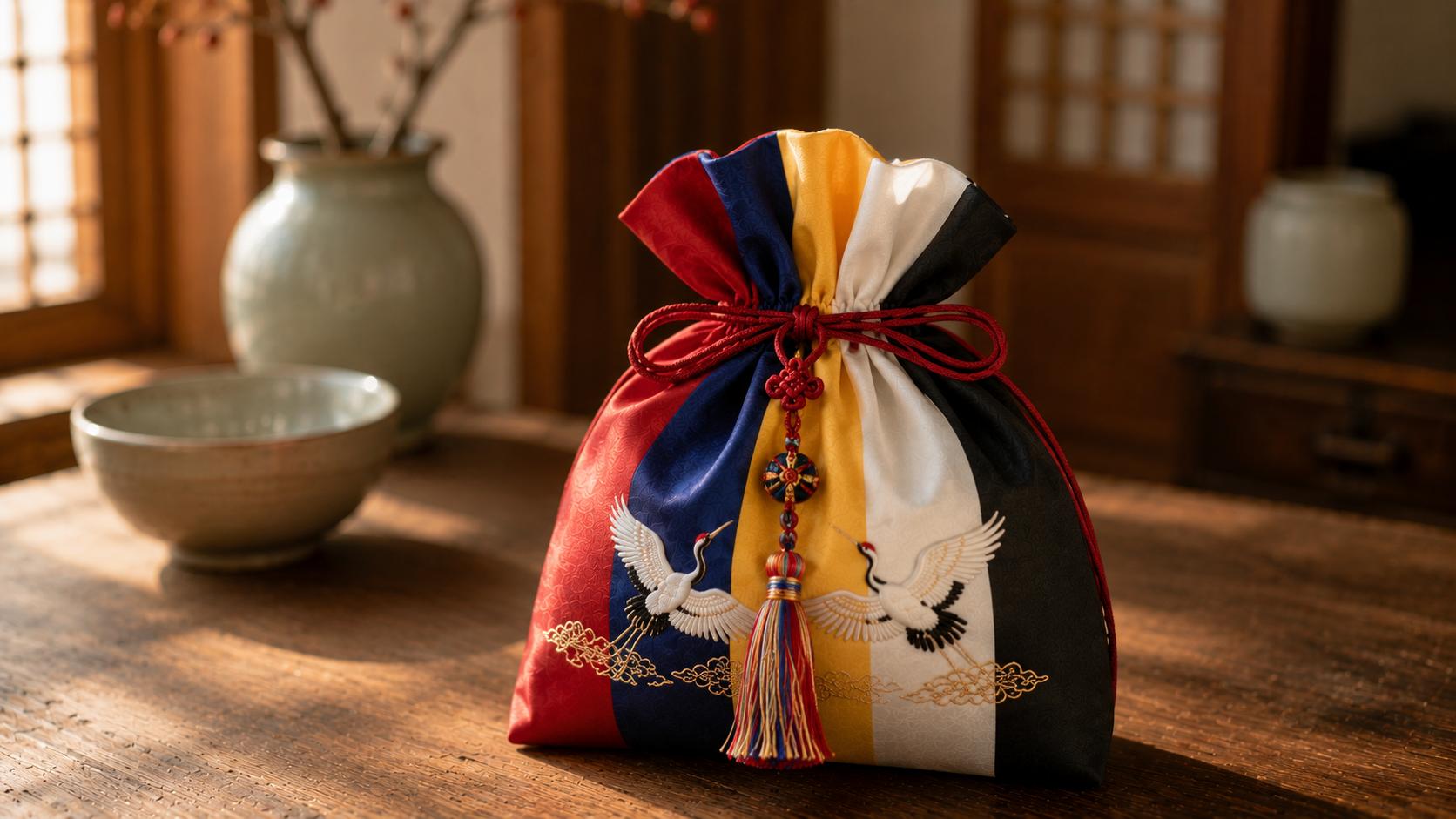
It is small enough to fit in one hand. It is made from silk, tied with a drawstring, and covered in bold stripes of red, blue, yellow, white, and black. It looks like a decorative pouch, and it is -- but it was also the closest thing traditional Korean clothing ever had to a pocket, a talisman, and a New Year's gift all at once. The BOKJUMEONI (복주머니) is one of the most quietly significant objects in Korean material culture, and its rainbow pattern carries a philosophy that goes back over a thousand years.
What BOKJUMEONI Actually Is
The name breaks down simply. "BOK" (복) means luck or fortune, and "JUMEONI" (주머니) means pocket or pouch. Put together, it is a lucky pouch -- a small drawstring bag designed to hold wishes, valuables, and good fortune. BOKJUMEONI come in many shapes, sizes, and colors, but the most iconic version is the SAEKDONG (색동) style, decorated with the vivid multicolored vertical stripes that have been one of the defining patterns in Korean textile tradition since at least the Three Kingdoms period.
Why Hanbok Has No Pockets
Traditional Korean clothing, HANBOK (한복), does not have pockets. This is not an oversight. The flowing silhouette of HANBOK, with its emphasis on clean lines and layered fabric, left no natural place for a built-in pocket. Instead, Koreans carried what they needed in small pouches worn on the outside of their clothes. The BOKJUMEONI was one of these pouches. It was attached to the belt, hung from the clothing, or carried by hand, functioning as both a practical container and a visible accessory. The absence of pockets in HANBOK made the pouch not a secondary item but a necessary one.
The Stripes Are Not Just Decoration
SAEKDONG (색동) literally means "colorful strips." The pattern is created by joining together bands of fabric in different colors, either through dyeing or by sewing separate strips side by side. What looks like a simple striped pattern carries a layered meaning rooted in Korean cosmology. The stripes of equal width were understood to represent equality, peace, and balance -- not just an aesthetic choice, but a statement of philosophy embedded in cloth. SAEKDONG appears across Korean textile culture: in the sleeves of children's HANBOK, in ceremonial garments, in wrapping cloths, and in the BOKJUMEONI carried during festivals and the New Year.
Five Colors, Five Elements
The colors in SAEKDONG are not chosen at random. They are rooted in OBANGSAEK (오방색), the traditional Korean five-color system derived from the Confucian concept of yin, yang, and the five elements. The five core colors are blue, red, yellow, white, and black. Each represents a direction, a natural element, and a cosmic force: blue for the east and wood, red for the south and fire, yellow for the center and earth, white for the west and metal, black for the north and water. Together they form a complete system. Wearing or carrying SAEKDONG was understood as an act of alignment with these forces -- a way of inviting balance, harmony, and protection into one's life. Children especially were dressed in SAEKDONG to ward off evil spirits and bring them health.
Who Wore It and When
BOKJUMEONI was worn by everyone regardless of gender or class during the Joseon period, though the materials and embellishments varied by status. Royalty and aristocrats carried pouches made from fine silk with elaborate embroidery -- lotus flowers, mandarin ducks, cranes, and landscapes stitched in careful detail. Commoners carried simpler versions in cotton. The most important occasion for giving and receiving BOKJUMEONI was SEOLLAL (설날), the Lunar New Year. Elders gave BOKJUMEONI filled with money, rice, or small lucky items to children as New Year's gifts, a tradition that linked the object directly to the start of a new year and the hopes carried into it. Children would attach the pouches to their HANBOK and wear them throughout the first days of the year.
What Goes Inside
The contents of a BOKJUMEONI were chosen with intention. Coins were the most common item, placed inside to attract wealth. Rice was included to represent abundance and a full table. Small amulets or written wishes could also be placed inside. In some traditions, specific items were chosen based on the year of the lunar calendar or the particular wish being made. The pouch was not simply a container for valuables -- it was understood to actively concentrate and amplify the energy of what it held. The act of filling a BOKJUMEONI and giving it away was itself a ritual of wishing well.
BOKJUMEONI Today
The SAEKDONG BOKJUMEONI remains one of the most recognizable symbols of Korean New Year culture. During SEOLLAL, it appears across Korea as a seasonal decoration, a gift wrap, a souvenir, and a fashion accessory worn with modern HANBOK. Department stores and traditional craft shops stock them in every size, from small coin-purse versions to large decorative pieces used in interior displays. International interest in Korean culture has made BOKJUMEONI one of the more accessible entry points into traditional Korean design -- compact, visually striking, and rooted in a system of meaning that rewards closer attention. The stripes that look like simple color blocks carry a complete cosmology inside them.