
JANG (장): The Three Fermented Pastes Behind Korean Cooking
In This Article
Korea Has Been Fermenting the Same Three Pastes for Over 2,000 Years
Most people who eat Korean food have tasted JANG (장) without knowing it. The deep, savory base of doenjang jjigae. The red heat of tteokbokki sauce. The salty depth of a simple bowl of rice with soy sauce. All of it comes from the same three fermented pastes that Koreans have been making for over two millennia: DOENJANG (된장), GANJANG (간장), and GOCHUJANG (고추장). Koreans call these the holy trinity of their kitchen, and that is not an exaggeration.
What JANG Actually Means
JANG is not a single ingredient. It is a category. The word refers to fermented condiments made primarily from soybeans, salt, and time. What makes JANG different from other fermented foods around the world is that the process produces multiple products simultaneously. DOENJANG and GANJANG are not separate recipes. They come from the same fermentation process. When soybeans are fermented, the liquid that separates becomes GANJANG. The solid that remains becomes DOENJANG. One process, two products, zero waste. Koreans figured this out more than 2,000 years ago.
The Science Behind the Depth
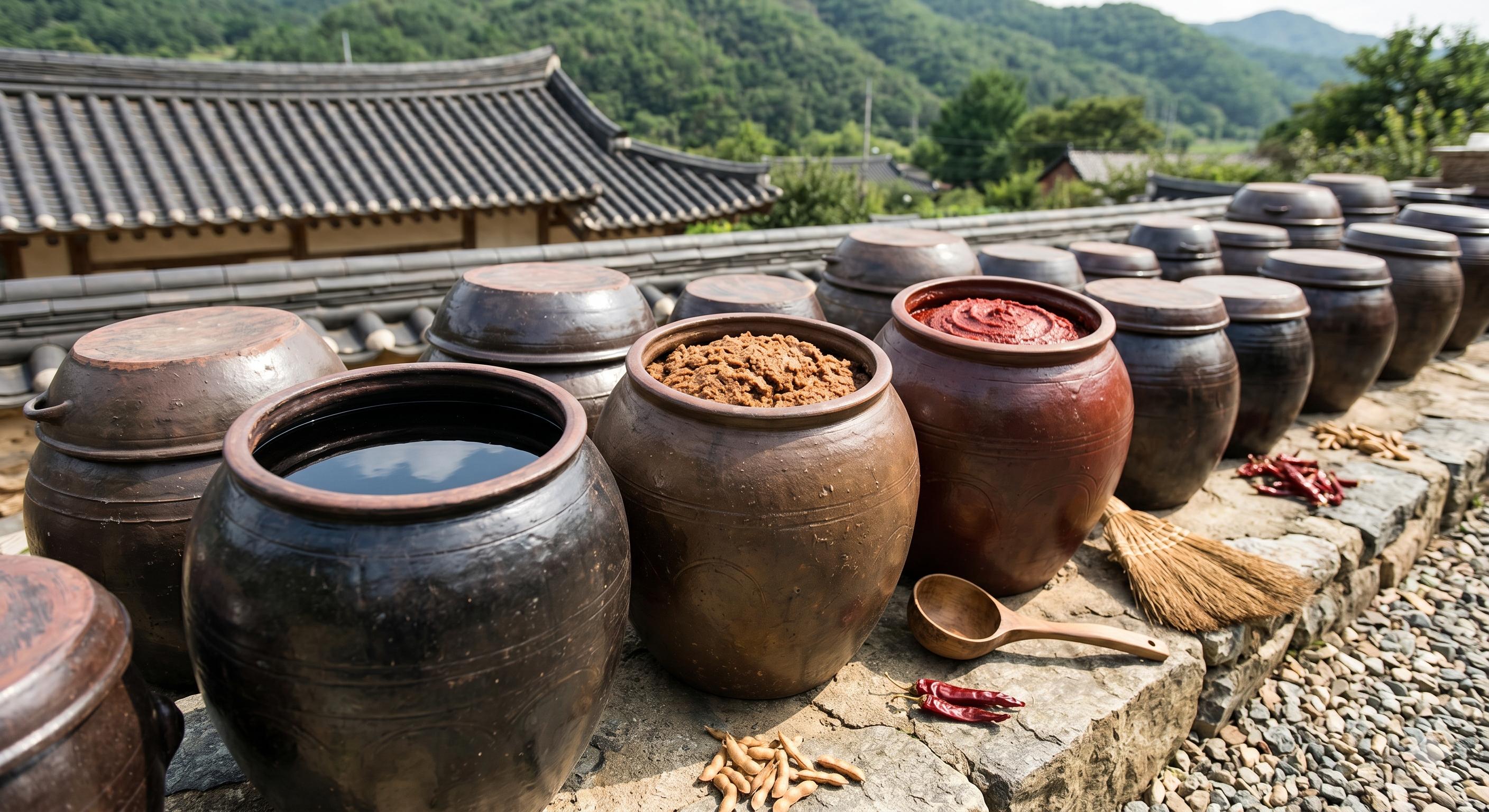
The flavor complexity in JANG comes from a microorganism called Aspergillus oryzae, the same mold responsible for miso, sake, and soy sauce across Asia. But the Korean version of fermentation has distinct characteristics. Traditional Korean JANG is fermented in ONGGI (옹기), unglazed earthenware pots that are slightly porous. This porosity allows oxygen to pass through the walls of the pot, creating a microenvironment that supports the growth of beneficial bacteria while suppressing harmful ones. The result is a fermented product with a different microbial profile than factory-made versions. Studies have identified over 200 volatile compounds in traditionally fermented DOENJANG, contributing to a flavor complexity that simply cannot be replicated in a factory setting. The gut health benefits are real too. Traditional JANG is rich in Bacillus subtilis, a probiotic strain that supports digestion and immune function.
DOENJANG: The One That Smells Strange and Tastes Like Home
DOENJANG is the paste that non-Koreans are most likely to find confronting on first encounter. The smell is strong. The flavor is intense. It is earthy, pungent, and deeply savory in a way that is hard to describe without just tasting it. For Koreans, that smell is the smell of home. It is the smell of a pot simmering on the stove, of a grandmother's kitchen, of something that has been part of daily life for so long that it has become inseparable from memory. DOENJANG jjigae, the stew made from this paste, consistently ranks as one of the most comforting and most missed foods among Koreans living abroad. It is not a fancy dish. It is a pot of fermented soybean paste boiled with tofu and vegetables. But it carries an emotional weight that no other dish quite matches.
GANJANG: Not Just Soy Sauce
Foreigners often assume GANJANG is just Korean soy sauce. It is not. Japanese soy sauce, Chinese soy sauce, and Korean GANJANG are all fermented from soybeans, but the production methods and flavor profiles are significantly different. Korean GANJANG made through traditional methods has a more complex, less sweet flavor than Japanese shoyu, and a deeper umami than most Chinese varieties. There are also two completely different types of GANJANG in Korea. JOSEON GANJANG (조선간장), also called GUKGANJANG, is the traditionally fermented version, darker and more intensely flavored, used mainly in soups and traditional dishes. YANGJO GANJANG is the modern, factory-produced version more commonly used today. Knowing which one a recipe calls for makes a real difference in the final result.
GOCHUJANG: The Youngest of the Three
GOCHUJANG is the most globally recognized of the three, largely because of its role in dishes like bibimbap and tteokbokki that have gone viral internationally. But it is also the youngest. Chili peppers did not exist in Korea until they were introduced after the Japanese invasions of the 1590s. Before that, Korean food was spiced primarily with black pepper and ginger. GOCHUJANG as it exists today has only been around for about 400 years. Yet it integrated so completely into Korean cuisine that most Koreans cannot imagine cooking without it. The best GOCHUJANG comes from Sunchang (순창), a region in North Jeolla Province where the climate and water conditions produce a paste with a distinct sweetness and depth that has earned it protected geographical status in Korea.
The JANGDOK: A Kitchen Outside the Kitchen
Traditionally, every Korean household kept a collection of ONGGI pots called JANGDOK (장독) on an elevated platform called a JANGDOKDAE (장독대), usually placed in a sunny spot in the yard to maximize fermentation conditions. These pots held the family's JANG supply, often aged for years or even decades. The condition of the JANGDOK was considered a reflection of the household's diligence and the quality of the family's cooking. When a daughter left home to get married, her mother would often give her a pot of JANG as part of her preparation for running her own household. The JANG was not just food. It was a transfer of knowledge, culture, and care that had been accumulated over generations.
Why This Matters Beyond the Kitchen
Korea is one of the few countries in the world where fermented condiments are still made at home by a significant portion of the population. The practice of JANG DAMGGI (장 담그기), the annual ritual of making JANG, was inscribed on UNESCO's Intangible Cultural Heritage list in 2024. This recognition was not just about food preservation. It was about recognizing that the knowledge embedded in this practice, the understanding of microorganisms, seasonal timing, soil, water, and craft, represents a form of cultural knowledge that took thousands of years to develop. Every jar of traditionally made JANG is the result of a process that connects the person making it to every generation that made it before them. That is what fermentation does. It holds time inside it.